Editor’s Note: Since this article was originally published, the U.S.–Iran agreement referenced has not progressed as anticipated, and conditions remain fluid. We remain optimistic that a constructive resolution will emerge. In the meantime, the analysis below continues to reflect the underlying dynamics shaping oil and lubricant supply chains—and the challenges industrial organizations should plan for.
Executive Summary
Kem Krest’s Matt McGinnis, Chief Commercial Officer, shares a grounded perspective on:
- The reality of constrained supply and why normalization won’t be immediate
- How volatility may continue to impact planning decisions in the near term
- What leaders should be watching as conditions evolve
The current oil supply disruption is not expected to resolve quickly despite the recent U.S.–Iran agreement. While crude oil prices have reacted immediately, the downstream lubricant supply chain—including base oil production, additive blending, and finished products—will take significantly longer to recover. Structural constraints such as limited Group III base oil availability, refinery economics favoring fuel production, and ongoing global logistics challenges are expected to delay normalization. For industrial supply chains, this means continued volatility in availability, pricing, and lead times, reinforcing the need for proactive sourcing strategies and stronger supplier partnerships.
Introduction
A peace deal between Iran and the USA is a step in the right direction for supplies and prices of automotive lubricants to normalize, but it will take time for the impact to be felt by consumers.
Where We Are at the Moment of the Deal (June 17, 2026)
The current lubricant supply crisis was triggered by U.S./Israeli strikes on Iran on February 28, 2026, after which Iran closed the Strait of Hormuz to vessels going to or from U.S., Israeli, or allied ports. On April 13, 2026 the U.S. imposed a naval blockade in response to Iran’s blockade, ensuring that passage through the strait was not unilaterally controlled by Iran as a mechanism to exploit carriers for fees to traverse the Strait. The Strait carries roughly 20% of global oil flows, and the Aramco CEO publicly stated on May 11 that cumulative supply disruption from the crisis had already exceeded ~1 billion barrels and that oil-market normalization could be pushed into 2027 even if
Hormuz reopened promptly.
The deal itself was announced June 14, is expected to be signed June 19 in Switzerland, with the Strait to be reopened within 30 days (approximately midJuly 2026). Crude reacted immediately: WTI fell to ~$79.50/bbl and Brent settled at a threemonth low. However, this immediate drop in crude oil prices won’t translate into price declines and supply availability of lubricants for many months to come.
A generic diagram of the lubricant supply chain is shown below.
Lubricant Supply Chain from Crude to Finished Motor Oil
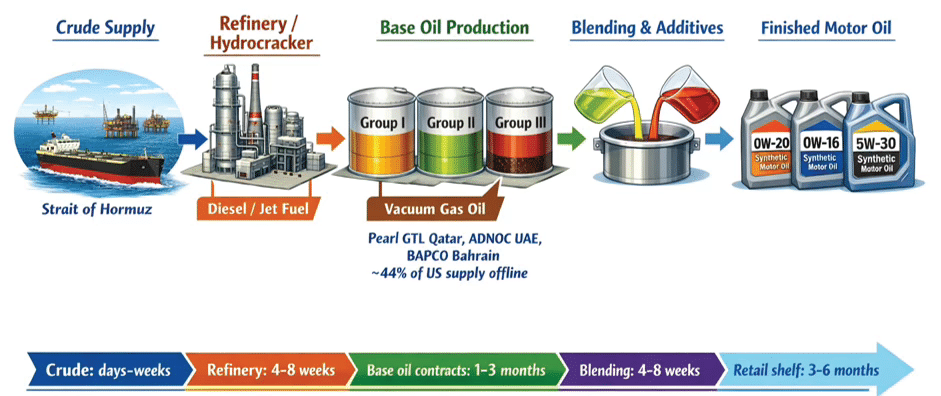
Figure 1: Transmission chain from Persian Gulf crude through refinery slate decisions, Group I/II/III base oil production, and additive blending to finished passenger car motor oil — the path along which a peace-deal price signal must travel before
Why Finished Lubricant Recovery Lags Crude Recovery
Crude markets reprice in minutes; the lubricants supply chain reprices in months. JobbersWorld’s June 15 postdeal analysis is the most direct statement of this asymmetry: the peace deal “may reduce cruderelated pressure quickly, but lubricant price relief is likely to lag,” and the most realistic outlook is “staged recovery: crude and freight first, broader base oil stabilization next, Group III and synthetic lubricant normalization later”.
There are five compounding reasons:
- Most Group III feedstock economics are linked to diesel/jet, not crude. With Asian diesel margins at 40year highs and Singapore gasoil prices roughly tripling between January and April 2026, Korean refiners (SOil, GS Caltex, SK Innovation — ~30% of U.S. Group III) routed vacuum gas oil to fuels rather than base oils. Lower crude only restores baseoil economics once the crack spread between diesel and base oils narrows — a process that lags spot crude by months.
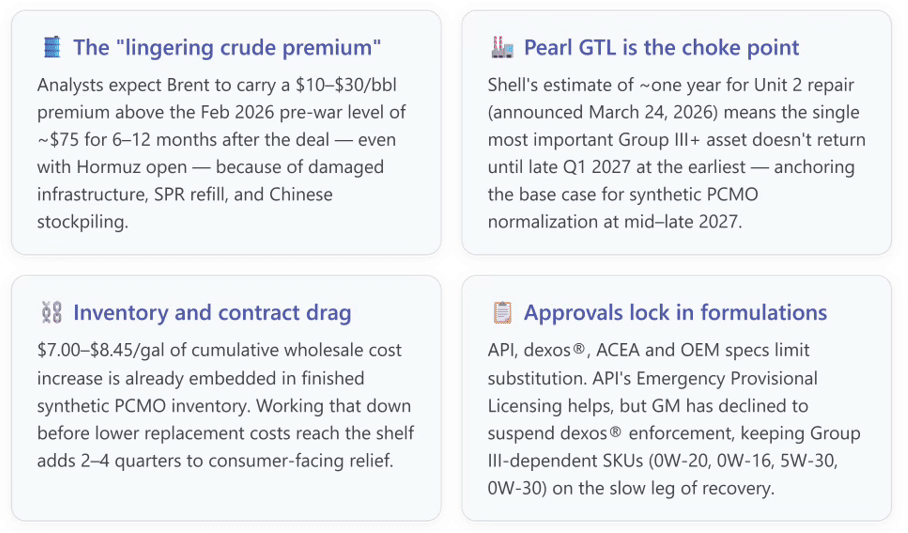
- Physical damage takes physical time to repair. Shell’s Pearl GTL Unit 2 (~30,000 bbl/day of Group III+ capacity) needs roughly one year of repairs following March 18 attacks, putting a partial restart no earlier than March 2027. Restarting damaged hydrocracking and gastoliquids units requires safety inspections, specialized equipment (e.g., large gas turbines), and certified commissioning.
- Inventory and contract lag. Suppliers and distributors are holding base oil, additives, packaging and freight purchased at peakcrisis costs. Per JobbersWorld, “even if crude oil prices fall quickly, the industry must work through inventories, contracts, freight commitments, and raw material purchases made under very different market conditions”. JobbersWorld also tracked the 2026 cycle as the highestmagnitude lubricant pricing event on record at +22% on average, and the shortest in duration at just 91 days — but high magnitude means inventory carries a heavier headwind on the way down.
- Formulation and OEM approvals limit substitution. Modern engine oils carry API, Dexos®, ACEA and OEM approvals built around specific Group III slates. Blenders cannot simply swap in Group II without requalification. API has activated Emergency Provisional Licensing and ILMA has asked GM for flexibility on Dexos®, but GM has declined to suspend enforcement — so the formulation gate stays largely closed.
- The “war risk insurance gate.” Lloyd’s of London warrisk premiums hit 16× precrisis levels at peak. Underwriters typically require 2–4 weeks of incidentfree transits before reducing rates, and a return to precrisis premiums can take 3–6 months after consistent safe passage. Until insurance premiums fall below ~4× normal, many operators cannot economically justify Hormuz transits.
Key Headwinds That Could Delay Normalization
Headwind 1: U.S. SPR Refill
The Strategic Petroleum Reserve has been one of the few buffers absorbing the Hormuz shock and is now structurally depleted:
- SPR level on May 15, 2026: 374.2 million barrels (~51% of authorized capacity; ~48% below the 2010 peak of 726.6 MMbbl).
- The reserve experienced two consecutive alltime weekly drawdown records in May (8.6 MMbbl then 9.92 MMbbl).
- Drawdown capacity is 4.4 million bbl/day; refill capacity is only 785,000 bbl/day — a ~5.6to1 asymmetry. Refilling the cumulative May 2026 draw alone (~35 MMbbl) requires ~45 days at peak fill; rebuilding from 374 MMbbl to the 2010 peak would take ~15 months at peak fill, assuming no further draws.
- Realistic congressional appropriation and DOE solicitation cadence stretches that timeline across multiple years.
Implication: Sustained SPR refill buying programs typically run at ~3 MMbbl/month (the Trump administration’s January 2026 announcement was 1 MMbbl). This is a steady marginal bid that supports crude prices and keeps a floor of perhaps $5–$10/bbl above the unconstrained equilibrium for an extended period — translating into stickier baseoil and finishedlubricant cost pass-throughs throughout 2026 and into 2027.
Headwind 2: Chinese Strategic Stockpiling
- China has been adding ~1 million bbl/day to reserves during much of 2025 and is expected to continue stockpiling through 2026, per Gunvor and S&P Global.
- China is adding 11 new oil reserve sites in 2025 and 2026 and Sinopec / CNOOC plan to add at least 169 million barrels of storage capacity.
- China’s filling rate is around 60%, meaning meaningful room for additional stockpiling.
Implication: Chinese strategic buying competes with U.S. SPR refill for the same marginal barrel. As long as Brent trades below the ~$80–$85/bbl band, both buyers tend to step up. This stickiness in physical demand can extend the “lingering risk premium” of $10–30/bbl above precrisis levels by 3–6 months versus what crude fundamentals alone would imply.
Headwind 3: OPEC+ Discipline and the Nuclear Track
- OPEC+ production increases agreed during the crisis “will begin to flow — adding downward pressure on prices” — a partial offset to SPR/China headwinds.
- The MoU includes a 30–60 day nuclear negotiation window. If talks collapse, the Strait could close again — a tail risk that insurers, refiners and shipowners are pricing for months after the deal.
- This combination is why analysts at ANZ have warned that oil prices “will remain a little bit on the higher side only because infrastructure has been damaged”.
Headwind 4: Korean refining slate stays diesel-skewed
With diesel margins still well above historical norms, Korean refiners (S-Oil, GS Caltex, SK Innovation) — the largest non-Middle East source of U.S. Group III — are economically incentivized to keep routing VGO to diesel rather than base oils until the crack spread normalizes. ILMA estimates this dynamic alone could persist for several quarters even after Hormuz fully reopens.
Strategic Implications for Lubricant Distributors and OEM Customers
This recovery profile creates a bifurcated commercial environment for at least 12–18 months:
- Conventional / Group II–dependent SKUs (HDEO 15W40, conventional 10W30, 5W30 conventional): Faster relief expected from late 2026; carrying too much highcost inventory will compress margins as replacement costs decline.
- Synthetic / Group III–dependent SKUs (0W20, 0W16, 0W8, Dexos®approved 5W30): Continued allocation, price stickiness, and selective shortages. Distributors should maintain disciplined inventory and customer communication around the uneven recovery, because customers are likely to ask “why hasn’t motor oil dropped with crude?” once Brent prints in the $80s.
- Channel pricing: Oil majors will be slow to roll back announced increases given replacementcost discipline and the nucleartrack tail risk.
Learn More
Explore Kem Krest’s capabilities for risk-proofing your supply chain
Start the conversation → speak to a Kem Krest supply chain expert
Sources
1. JobbersWorld / Petroleum Trends International – “After the Peace Deal: The Uneven Road to Lubricant Market Recovery” by Thomas F. Glenn (June 15, 2026) — https://jobbersworld.com/2026/06/15/after-the-peace-deal-the-uneven-road-to-lubricant-market-recovery
2. Hormuz Strait Monitor – Live closure / reopening tracker — https://hormuzstraitmonitor.com
3. Gas Price Check – https://www.gas-price-check.com/research/the-2026-motor-oil-squeeze
4. Independent Lubricant Manufacturers Association (www.ilma.org) ILMA Customer Info: Base Oil Supply Crisis (May 2026). ILMA Industry Communications.
6. JobbersWorld – “Qatar Supply Disruptions Hit Pearl GTL” (March 20, 2026) — https://jobbersworld.com
7. U.S. EIA – SPR Weekly Inventory Data — https://www.eia.gov/dnav/pet/hist/LeafHandler.ashx?n=PET&s=MCSSTUS1&f=M
8. UNCTAD – Strait of Hormuz Disruptions: Growth and Financial Implications (April 1, 2026) — https://unctad.org
Editor’s Note: Since this article was originally published, the U.S.–Iran agreement referenced has not progressed as anticipated, and conditions remain fluid. We remain optimistic that a constructive resolution will emerge. In the meantime, the analysis below continues to reflect the underlying dynamics shaping oil and lubricant supply chains—and the challenges industrial organizations should plan for.
Executive Summary
Kem Krest’s Matt McGinnis, Chief Commercial Officer, shares a grounded perspective on:
- The reality of constrained supply and why normalization won’t be immediate
- How volatility may continue to impact planning decisions in the near term
- What leaders should be watching as conditions evolve
The current oil supply disruption is not expected to resolve quickly despite the recent U.S.–Iran agreement. While crude oil prices have reacted immediately, the downstream lubricant supply chain—including base oil production, additive blending, and finished products—will take significantly longer to recover. Structural constraints such as limited Group III base oil availability, refinery economics favoring fuel production, and ongoing global logistics challenges are expected to delay normalization. For industrial supply chains, this means continued volatility in availability, pricing, and lead times, reinforcing the need for proactive sourcing strategies and stronger supplier partnerships.
Introduction
A peace deal between Iran and the USA is a step in the right direction for supplies and prices of automotive lubricants to normalize, but it will take time for the impact to be felt by consumers.
Where We Are at the Moment of the Deal (June 17, 2026)
The current lubricant supply crisis was triggered by U.S./Israeli strikes on Iran on February 28, 2026, after which Iran closed the Strait of Hormuz to vessels going to or from U.S., Israeli, or allied ports. On April 13, 2026 the U.S. imposed a naval blockade in response to Iran’s blockade, ensuring that passage through the strait was not unilaterally controlled by Iran as a mechanism to exploit carriers for fees to traverse the Strait. The Strait carries roughly 20% of global oil flows, and the Aramco CEO publicly stated on May 11 that cumulative supply disruption from the crisis had already exceeded ~1 billion barrels and that oil-market normalization could be pushed into 2027 even if
Hormuz reopened promptly.
The deal itself was announced June 14, is expected to be signed June 19 in Switzerland, with the Strait to be reopened within 30 days (approximately midJuly 2026). Crude reacted immediately: WTI fell to ~$79.50/bbl and Brent settled at a threemonth low. However, this immediate drop in crude oil prices won’t translate into price declines and supply availability of lubricants for many months to come.
A generic diagram of the lubricant supply chain is shown below.
Lubricant Supply Chain from Crude to Finished Motor Oil
Figure 1: Transmission chain from Persian Gulf crude through refinery slate decisions, Group I/II/III base oil production, and additive blending to finished passenger car motor oil — the path along which a peace-deal price signal must travel before
Why Finished Lubricant Recovery Lags Crude Recovery
Crude markets reprice in minutes; the lubricants supply chain reprices in months. JobbersWorld’s June 15 postdeal analysis is the most direct statement of this asymmetry: the peace deal “may reduce cruderelated pressure quickly, but lubricant price relief is likely to lag,” and the most realistic outlook is “staged recovery: crude and freight first, broader base oil stabilization next, Group III and synthetic lubricant normalization later”.
There are five compounding reasons:
- Most Group III feedstock economics are linked to diesel/jet, not crude. With Asian diesel margins at 40year highs and Singapore gasoil prices roughly tripling between January and April 2026, Korean refiners (SOil, GS Caltex, SK Innovation — ~30% of U.S. Group III) routed vacuum gas oil to fuels rather than base oils. Lower crude only restores baseoil economics once the crack spread between diesel and base oils narrows — a process that lags spot crude by months.
- Physical damage takes physical time to repair. Shell’s Pearl GTL Unit 2 (~30,000 bbl/day of Group III+ capacity) needs roughly one year of repairs following March 18 attacks, putting a partial restart no earlier than March 2027. Restarting damaged hydrocracking and gastoliquids units requires safety inspections, specialized equipment (e.g., large gas turbines), and certified commissioning.
- Inventory and contract lag. Suppliers and distributors are holding base oil, additives, packaging and freight purchased at peakcrisis costs. Per JobbersWorld, “even if crude oil prices fall quickly, the industry must work through inventories, contracts, freight commitments, and raw material purchases made under very different market conditions”. JobbersWorld also tracked the 2026 cycle as the highestmagnitude lubricant pricing event on record at +22% on average, and the shortest in duration at just 91 days — but high magnitude means inventory carries a heavier headwind on the way down.
- Formulation and OEM approvals limit substitution. Modern engine oils carry API, Dexos®, ACEA and OEM approvals built around specific Group III slates. Blenders cannot simply swap in Group II without requalification. API has activated Emergency Provisional Licensing and ILMA has asked GM for flexibility on Dexos®, but GM has declined to suspend enforcement — so the formulation gate stays largely closed.
- The “war risk insurance gate.” Lloyd’s of London warrisk premiums hit 16× precrisis levels at peak. Underwriters typically require 2–4 weeks of incidentfree transits before reducing rates, and a return to precrisis premiums can take 3–6 months after consistent safe passage. Until insurance premiums fall below ~4× normal, many operators cannot economically justify Hormuz transits.
Key Headwinds That Could Delay Normalization
Headwind 1: U.S. SPR Refill
The Strategic Petroleum Reserve has been one of the few buffers absorbing the Hormuz shock and is now structurally depleted:
- SPR level on May 15, 2026: 374.2 million barrels (~51% of authorized capacity; ~48% below the 2010 peak of 726.6 MMbbl).
- The reserve experienced two consecutive alltime weekly drawdown records in May (8.6 MMbbl then 9.92 MMbbl).
- Drawdown capacity is 4.4 million bbl/day; refill capacity is only 785,000 bbl/day — a ~5.6to1 asymmetry. Refilling the cumulative May 2026 draw alone (~35 MMbbl) requires ~45 days at peak fill; rebuilding from 374 MMbbl to the 2010 peak would take ~15 months at peak fill, assuming no further draws.
- Realistic congressional appropriation and DOE solicitation cadence stretches that timeline across multiple years.
Implication: Sustained SPR refill buying programs typically run at ~3 MMbbl/month (the Trump administration’s January 2026 announcement was 1 MMbbl). This is a steady marginal bid that supports crude prices and keeps a floor of perhaps $5–$10/bbl above the unconstrained equilibrium for an extended period — translating into stickier baseoil and finishedlubricant cost pass-throughs throughout 2026 and into 2027.
Headwind 2: Chinese Strategic Stockpiling
- China has been adding ~1 million bbl/day to reserves during much of 2025 and is expected to continue stockpiling through 2026, per Gunvor and S&P Global.
- China is adding 11 new oil reserve sites in 2025 and 2026 and Sinopec / CNOOC plan to add at least 169 million barrels of storage capacity.
- China’s filling rate is around 60%, meaning meaningful room for additional stockpiling.
Implication: Chinese strategic buying competes with U.S. SPR refill for the same marginal barrel. As long as Brent trades below the ~$80–$85/bbl band, both buyers tend to step up. This stickiness in physical demand can extend the “lingering risk premium” of $10–30/bbl above precrisis levels by 3–6 months versus what crude fundamentals alone would imply.
Headwind 3: OPEC+ Discipline and the Nuclear Track
- OPEC+ production increases agreed during the crisis “will begin to flow — adding downward pressure on prices” — a partial offset to SPR/China headwinds.
- The MoU includes a 30–60 day nuclear negotiation window. If talks collapse, the Strait could close again — a tail risk that insurers, refiners and shipowners are pricing for months after the deal.
- This combination is why analysts at ANZ have warned that oil prices “will remain a little bit on the higher side only because infrastructure has been damaged”.
Headwind 4: Korean refining slate stays diesel-skewed
With diesel margins still well above historical norms, Korean refiners (S-Oil, GS Caltex, SK Innovation) — the largest non-Middle East source of U.S. Group III — are economically incentivized to keep routing VGO to diesel rather than base oils until the crack spread normalizes. ILMA estimates this dynamic alone could persist for several quarters even after Hormuz fully reopens.
Strategic Implications for Lubricant Distributors and OEM Customers
This recovery profile creates a bifurcated commercial environment for at least 12–18 months:
- Conventional / Group II–dependent SKUs (HDEO 15W40, conventional 10W30, 5W30 conventional): Faster relief expected from late 2026; carrying too much highcost inventory will compress margins as replacement costs decline.
- Synthetic / Group III–dependent SKUs (0W20, 0W16, 0W8, Dexos®approved 5W30): Continued allocation, price stickiness, and selective shortages. Distributors should maintain disciplined inventory and customer communication around the uneven recovery, because customers are likely to ask “why hasn’t motor oil dropped with crude?” once Brent prints in the $80s.
- Channel pricing: Oil majors will be slow to roll back announced increases given replacementcost discipline and the nucleartrack tail risk.
Learn More
Explore Kem Krest’s capabilities for risk-proofing your supply chain
Start the conversation → speak to a Kem Krest supply chain expert
Sources
1. JobbersWorld / Petroleum Trends International – “After the Peace Deal: The Uneven Road to Lubricant Market Recovery” by Thomas F. Glenn (June 15, 2026) — https://jobbersworld.com/2026/06/15/after-the-peace-deal-the-uneven-road-to-lubricant-market-recovery
2. Hormuz Strait Monitor – Live closure / reopening tracker — https://hormuzstraitmonitor.com
3. Gas Price Check – https://www.gas-price-check.com/research/the-2026-motor-oil-squeeze
4. Independent Lubricant Manufacturers Association (www.ilma.org) ILMA Customer Info: Base Oil Supply Crisis (May 2026). ILMA Industry Communications.
6. JobbersWorld – “Qatar Supply Disruptions Hit Pearl GTL” (March 20, 2026) — https://jobbersworld.com
7. U.S. EIA – SPR Weekly Inventory Data — https://www.eia.gov/dnav/pet/hist/LeafHandler.ashx?n=PET&s=MCSSTUS1&f=M
8. UNCTAD – Strait of Hormuz Disruptions: Growth and Financial Implications (April 1, 2026) — https://unctad.org